
OBITUARY
Christopher Casey Caldwell
August 29, 1946 – August 6, 2026
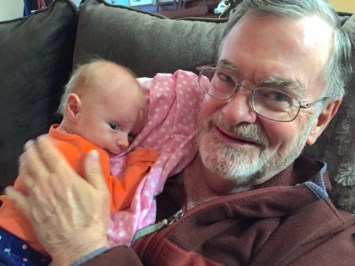
My Dad was born in New York in 1946, and grew up in Prairie Village, Kansas. He served in the Navy from 1968 to 1972, enlisting proactively when he was worried he otherwise would get drafted into the Army and sent to Vietnam. After serving the country, he moved to Lawrence and attended journalism school at the University of Kansas. He met my mom there; they married, and had my brother and me. He worked much of his career as an editor for Golf Course Management magazine. He loved fly fishing, as much for the nature and company as the actual fishing. In his later years, he served on the boards of multiple local organizations, including one dedicated to drug abuse and mental health treatment.
That’s what he did. But as he often said, we’re human beings, not human doings.
He and my mom divorced when I was young enough that I have no memories of them together. When he went to work for the golf course magazine, it wasn’t because he loved turfgrass. It was so he could stay close to my brother and me and be part of our growing up. Despite their differences, not once did I hear my Dad speak critically of our Mom.
When I was about 15, I had taken up running. This meant that I often asked to be taken, before sunrise, to some local 5k or 10k. In one case, his maroon Isuzu Trooper kept overheating. It was a terrible vehicle. But he wasn’t going to let me miss the race. He figured out how to put it in neutral and coast most of the way, only briefly turning on the engine to get up hills or get going after a red light. I got to the race on time.
I don’t recall the race at all. I remember the adventure of getting there, and Dad’s commitment to completing the mission.
More recently, as his health has declined, he grew more open with us about his role in different community groups, including 12-steps. He had quit drinking and smoking decades ago, but still valued the camaraderie and the opportunity to help others. The people he impacted over the years came out of the woodwork.
Shortly after he moved to California, to be in an assisted living close to us, the cards started coming. This one was signed by eight people, that one by 20. Many came with heartfelt messages about the impacts he had – quietly, patiently, without any expectation that the story would ever need to be told – on people’s lives.
This man was loved. And he was good.
Ever the editor, he would ask me to pick a different word there. “Good” can be a relative term; he had no use for such comparisons. But I mean it explicitly in the moral sense.
He bore no anger. The fiercest thing about him was his sense of right and wrong. He forgave people their idiosyncrasies, and was often charmed by them. He believed that the healing of pain was a worthy and everlasting community project. Something we all owe to one another.
There’s an old Betty White interview where she explains that she never feared death, because when she was a child, her family treated the passing of someone close to them as a joyous occasion in addition to being a sad one. Whoever died would be sorely missed, of course. But they also had gotten to learn the secret that everyone on earth wants to know: What comes next. That was something to be celebrated.
Dad got to learn the secret on August 6, 2026.
Show your support
Send Flowers
Add a Memory
Share Obituary
Get Reminders
Services
Celebration of Life
- SEND FLOWERSSEND
FLOWERS SHARE OBITUARYSHARE
- GET REMINDERS
v.1.18.0