OBITUARY
Jacob "Jean" Seidenberg
February 14, 1930 – November 6, 2022
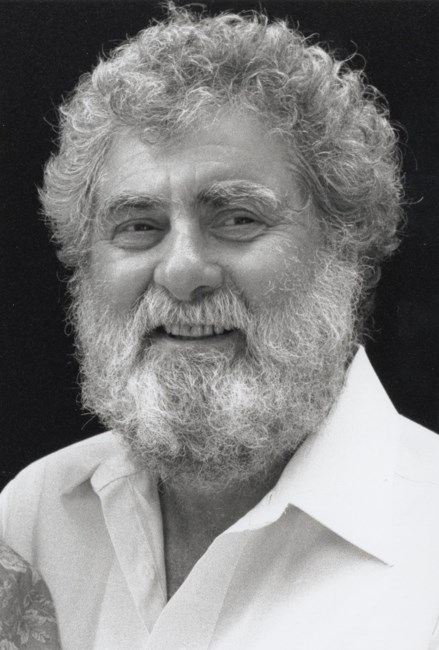
As a young child in Brooklyn, New York he drew constantly, once hopping onto a table and announcing to his cousins: “Tell me what to draw. I can draw anything!” From the age of 12, he haunted the great art museums and galleries of New York City “taking on every resource offered for drawing and painting.” He graduated from Erasmus Hall High School in 1947, earned scholarships to the Brooklyn Museum School (where he was told he was too young to work with Max Beckman) and Syracuse University Art School; he took evening classes at Cooper Union.
He moved to New Orleans with his first wife Judith Brett in the 1950s and made a living making “art about people, family and friends, some by commission.” He was a skilled draftsman and mechanic who worked in wood, bronze casting, mosaic as well as painting and drawing, supporting his family by taking on varied projects that came his way. He designed balls for the Mystic Club with celebrated food writer Lee Bailey from the 1950s to 70s. He was a founding member of the Orleans Gallery (1956), a pioneering, artist-owned space whose members also included sculptor Lin Emery, painters George Dunbar and Ida Kohlmeyer. He taught photography at Newcomb College. He organized and built the first independent foundry for lost wax casting in the south. He received a Tiffany Foundation Fellowship in Painting in 1960. In 1962, a portrait of his daughter “Eugenie” in a dark New Orleans interior was selected as one of 74 works of the Museum of Modern Art survey “Recent Painting USA –The Figure,” which traveled to nine venues nationally. For a time in the 1970s after his marriage broke up, he worked full time as a real estate developer.
He had resumed his career as a painter in 1981, when he met his second wife, Charlotte. On a first date, he showed her his 1950s studio and home and hangouts in the French Quarter and commissions around the city: the bronze portrait of George Burch MD in the lobby of Tulane Medical School, the welded "ornamental world map" on the International House building, gold tips on the wrought iron fence around Jackson Square which Clay Shaw commissioned for General de Gaulle’s visit, the welded steel figure in the Oil & Gas building, life-size bronzes and stations of the cross at St. Rita of Cascia Catholic Church in Harahan, mosaics, sculptures, paintings.
After 1980, he developed an active practice in portrait drawing and painting, while continuing to make non-commissioned “studio work” based on family, friends and the nude figure, in pencil, egg tempera, oil. In 2008, he was given a retrospective survey of his career at the Ogden Museum as a part of the museum’s Southern Masters Series. The associated book, focused on his work in the studio, begins with “A Portrait,” an overview of his life and a tribute to his immense talent by art critic and writer Chris Waddington: http://www.nxtbook.com/leh/jeanseidenberg/jeanseidenberg/index.php#/1
Jean said he got a kick out of “being deemed a Southern Master,” but his last words to Charlotte were, “You took care of your Yankee.” She responded, “My Brooklyn Jew.”
He was preceded in death by his daughter, Victoria Anne Seidenberg, his son, Brett Jonathan Seidenberg, his mother, Rebecca Goldstein Seidenberg, his father, Victor Seidenberg, his brother, Louis Seig, and his nephew, Joseph Seig. In addition to his wife, Charlotte Conti Seidenberg, he is survived by his daughter, Eugenie Seidenberg Delaney, his granddaughter, Madeline Jean Delaney of North Ferrisburgh, VT, his stepdaughter, Dara Rosenzweig of Corpus Christi, TX, his stepson, David Rosenzweig (Ariana Fancher) of Springfield, OR, his sister, Zelda Ann Seidenberg of Haslett, MI, his nephew, Sam Seig (Tegan Kossowicz) of Los Angeles, CA, and his niece, Melissa Squyres of Austin, TX.
His life will be celebrated at a later date.
Show your support
Add a Memory
Share Obituary
Get Reminders
SHARE OBITUARYSHARE
- GET REMINDERS
v.1.18.0