
OBITUARY
Rose Marie Sandecki
August 30, 1939 – September 19, 2026
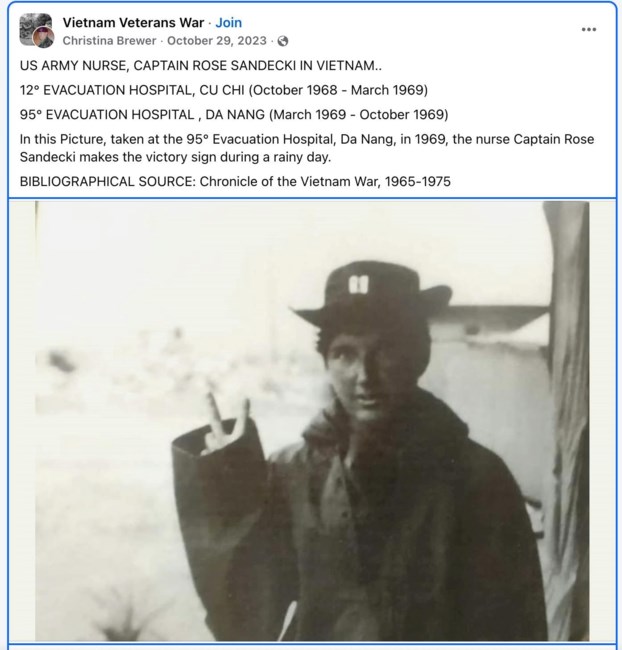
I had been in nursing about seven years, having graduated from a three-year nursing school and then gone back to school to get my BS in nursing. I had a couple of job opportunities, but none of them were that exciting to me. This was in the spring of '68, and the war was really building up. I remember watching the news every night, seeing in full, glorious color the stretchers with the young guys on them, really torn up, coming off the dustoffs. I felt I had some talents as a registered nurse, a professional nurse, and probably could offer something to those young men over there.
I went down to the Navy recruiter and was told I was too old (I was twenty-six or twenty-seven). The Air Force told me I would have to spend at least one year in the States before they would train me as a flight nurse, to go over to Vietnam. I said, "I want to go as soon as I can , while I feel like it, while I've got the spirit that has moved me." Only the Army would guarantee that I could be over within a certain period of time. So much so that they had the recruiter on the phone from Buffalo to Washington, D.C., letting me talk to the individuals there with a guarantee that I would be in Vietnam within three months. And that did happen indeed.
I went to the 12th Evac Hospital at Cu Chi. My first job was a head nurse, surgical intensive care unit, recovery room. I was a captain because I had seven years' experience in nursing and a bachelor's degree when I joined the Army. And in days of War they give rank out like candy. I had very little experience in recovery and no experience in surgical intensive care units. I had graduated from nursing school in 1960 when ICUs weren't around. They were just starting to be though tabout. When I was told my assignment would be head nurse of this ward, I said, "No, I don't want that," because I'd never set foot in an ICU. I quickly learned you never say no in the Army; I had this job whether I wanted it or not.
I couldn't believe the numbers of people coming in, the numbers of beds and the kinds of injuries that I saw in front of me - I really wasn't prepared for that. This was in October of '68, it was what they called "post-Tet" - after the Tet offensive - but it was extremely busy. As headnurse, my job was basically to see to it that all patients were taken care of as efficiently and quickly and in the best care possible. The Medical Corps motto was, and still is, I guess, "Preserve the fighting strength". The idea of working in a military hospital is to patch up the soldier so that he can go back in battle again. It was the whole theme of what was going on over there. It wouldn't be unusual when guys would come in with multiple frag wounds, be treated, go to surgery and have the tissue around the injury debrided, then be sent to Japan where they would do a DPC (delayed primary closure) of this open wound, and then sent back to duty. As long as an individual didn't lose a leg, arm, or an eye, as long as they were walking, they would go back to the boonies. So, my job as head nurse was to make sure the patients were taken care of - always helping. I mean, I didn't sit behind a desk and order the junior nurses or corpsmen around. I was pitching in with the rest of them.
When I look back on it, I was naive when I walked through those doors. I learned a lot very quickly, seeing the types of casualties and the numbers of them. They were all so young. Seeing this on a daily basis twelve to fourteen hours a day, six or seven days a week, I think that I became somewhat callous and bitter. You also learned that you became almost like a commodity because you were a woman. After working twelve-hour shifts with all the blood and gore, you would change into a civilian dress to go to one of the local officers' clubs. We were chauffeured in helicopters, with the guns on the side, that would take six or seven of us up to an officers' club. You couldn't sit still, just have a drink and relax. There would be one guy after another coming up and more or less doing his number on you: "I haven't seen a roundeye in six months. Would you dance with me?" You'd say, "No, I'm tired. I just want to sit and put my feet up." They wouldn't take no for an answer and would play this guilt thing like, "God, you don't know how bad I'm feeling. Just one dance, that's all." So you would dance and drink until two or three in the morning, then at six go back to the blood and guts of the war again. The initial two or three months was getting used to the pace of the twelve to thirteen hours of work and then the three or four hours of play. And it was a pressure kind of play because if you didn't go to the officers' club there was something wrong with you. If you stayed back in your hooch by yourself or stayed and talked to a couple of the other nurses, you were accused of being a lesbian, or you would be accused of having an affair with one of the doctors. You know, you are damned if you do and damned if you don't. After a period of four or five months, I decided that I really didn't care what people said about me. If I choose not to go to these clubs and parties, I'm not going to do it. . . and I probably became somewhat of a recluse. So those are some of the changes that I went through personally in Vietnam.
The way of dealing with the sheer amount of patients, the long hours in the hospital, was by putting up a wall, the emotional numbing that we talk about. I think it built up over a period of time. Each day I went in and the more I saw, the thicker this wall became; it was sort of a skin protecting me from what was going on. Look at it from the point of view of a patient: how would you, as a patient, feel if you had this hysterical nurse that was crying and sobbing because there is someone in there that is badly maimed or is going to die? We had to be effective for the next people that were coming in. Nurses are trained to take care of other people, not look at their own feelings and what is going on with them. That is part of the medical profession.
A story from Cu Chi, another example of the sort of rude awakening to my military naivete. I got a phone call on the ward from the chief nurse, saying, "You've got a patient there that is going to get an award. Make sure that the bed has clean sheets, the area is straightened up, and the ward looks good." Which really turned me off to begin with: Let's clean up the ward because we've got VlPs coming in. Well, the VIP happened to be the general of the 25th Infantry Division along with his aide and an entourage of about twelve people. And this patient, when he came through the recovery room the day before, had remembered me. This was his second visit to us. He had been there three months before with frag wounds, had been sent back to the jungle, and came back this time with both of his legs blown off - he was all of about twenty years old. When he was waking up from the anesthesia, he remembered me. He started kidding me about how I had made him cough and deep breathe so he wouldn't come down with pneumonia. We were kidding around, and he said, "Don't you remember me, ma'am?" I said, "Oh, yeah." But I really didn't because there were just so many of them....The entourage was coming to give him an award because he happened to be number twenty thousand to come through the 12th Evac Hospital.
In 1968 there were twenty-four Army evac hospitals in Vietnam, and he was number twenty thousand through one of twenty-four Army hospitals. We're not talking about tile Air Force hospitals, that Navy hospitals. . .but twenty thousand through one hospital. So, for this distinction, the general comes in and gives him a watch. They have this little ceremony, give him a Purple Heart and the watch. I'm standing off in the corner watching all this, and as the general handed him the watch - "From the25th Infantry Division as a token of our appreciation" - the kid more or less flings the watch back at him and says something like, "I can't accept this, sir; it's not going to help me walk." I couldn't really see the expression on the general's face, but they all left after this little incident. I went over and just put my arms around him and hugged him. . . and if I remember correctly, I started crying. . . and I think he was crying. I really admired him for that. That was one time that I let the feelings down and let somebody see what I felt. It took a lot for him to do that, and it sort of said what this war was all about to me.
From: Robert Marcus and David Burner, America Firsthand, volume 2, third edition (1983), pp.289-303
______________________________________________________________
Rose Sandecki joined the Army in 1968 to "offer something to those young men over there" as a professional nurse. Within three months, she'd been sent to the 12th Evac Hospital at Cu Chi as head nurse in the surgical intensive care recovery room. In the October 1968 "post-Tet" war, MEDDAC units like the one at Cu Chi were "extremely busy." As she pointed out in her interview, "The idea of working in a military hospital is to patch up the soldier so he can go back to the battle again."
She couldn't let her guard down very often because the hospital team had to keep being effective for the next round of casualties. Sandecki dealt with her exhaustion and emotional fatigue like so many others did, by building up a wall: "Each day I went in and the more I saw, the thicker this wall became; it was sort of a skin protecting me from what was going on."
For Sandecki, allowing herself to cry with the young amputee was the first step in a long struggle of letting in the pain and truth of war. "It was incredible coming back a real changed person, one who was sarcastic and bitter about what was happening in America."
After some disappointing civilian nursing experiences, she went back to school for a master's degree in counseling. In 1979, the Veterans Administration established 90 outreach centers to provide readjustment counseling and other services for Vietnam vets across the country. In 1984, at the time of Sandecki's interview, there were 136 centers.
She was appointed team leader of one of the centers in 1981: "So I'm an activist basically, a social activist for women in the military, especially those in Vietnam." Sandecki believes that people are more conscious now of the fact that women served in the war even if they didn't carry weapons.
Published from: US Military History: Sep 2, 2017
Show your support
Send a Gift
Add a Memory
Share Obituary
Get Reminders
Services
- Send Sympathy GiftsSEND
GIFTS SHARE OBITUARYSHARE
- GET REMINDERS
v.1.18.0